No installer, no account
One file on your wheelhouse PC, activated once against the vessel.
Per vesselOn board
Your Masters file at noon ship’s time, on the wheelhouse PC, with or without a link.
One file per vessel No installer and no account Nothing typed is ever lost

The terminal
One file on your wheelhouse PC, activated once against the vessel.
Per vesselThe form saves on board as your officer fills it, and goes ashore when a link opens.
No link requiredOn a thin link the noon report does not wait behind a defect photograph.
PrioritisedWhat your officer entered survives a closed lid, a lost link and a restart.
DurableAirtime
A noon report is a few hundred bytes. A photograph is three megabytes. Software that treats them the same is software your Master switches off.
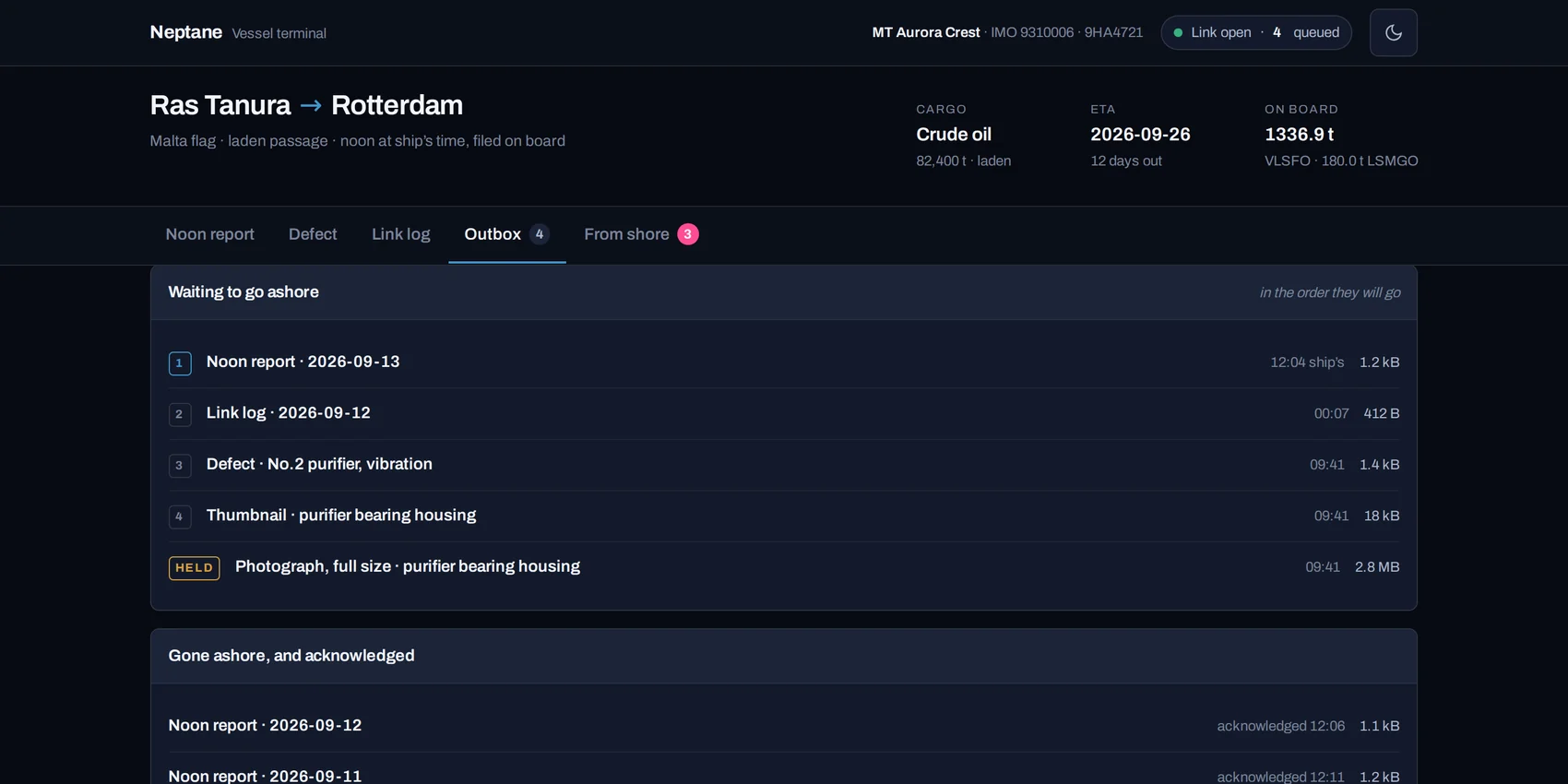
Your office does not poll the ship to find out whether she is reachable. The terminal keeps its own hourly record and sends the day’s record once, compressed, behind everything else. A month of it is smaller than one photograph.
The ship is sent what changed that concerns her — a certificate that moved, an approval, an alert — and nothing else. It arrives as a few hundred bytes a day, so the bridge is not the last to know and the bill does not notice.
The thumbnail goes with the defect so your superintendent can see what he is being told about. The full photograph stays on board, listed with its size, until somebody decides the link can afford it. It is still there a month later.
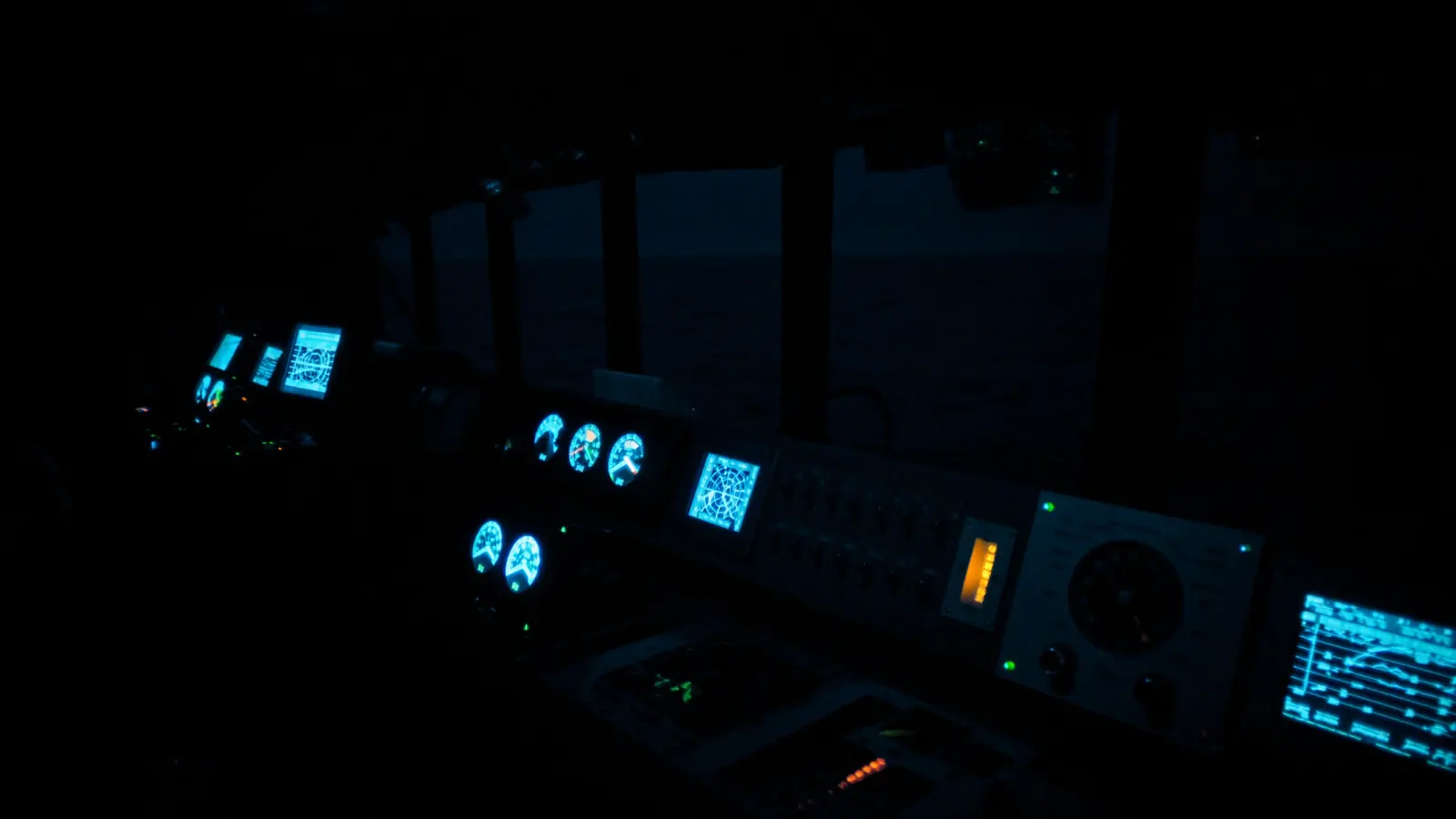
Built for the room it runs in.
A wheelhouse at midday is the brightest place this software runs, and the darkest place at three in the morning. Both renditions ship.
On the officer’s side
The fastest way to lose your fleet’s data is to argue with the man entering it at noon.
Where a figure falls outside what the vessel has established, the terminal states the range it expected and asks for a line of explanation. The figure is accepted either way, and your office receives both.
Where a tank has been sounded and the sounding disagrees with the book, the book stands and the sounding is kept beside it with the tolerance named. That is how it is settled on a real ship.
Nothing on board is overwritten. A correction is recorded as a movement, dated and attributed, so your figure ashore and the figure aboard tell the same story afterwards.
Proof of service
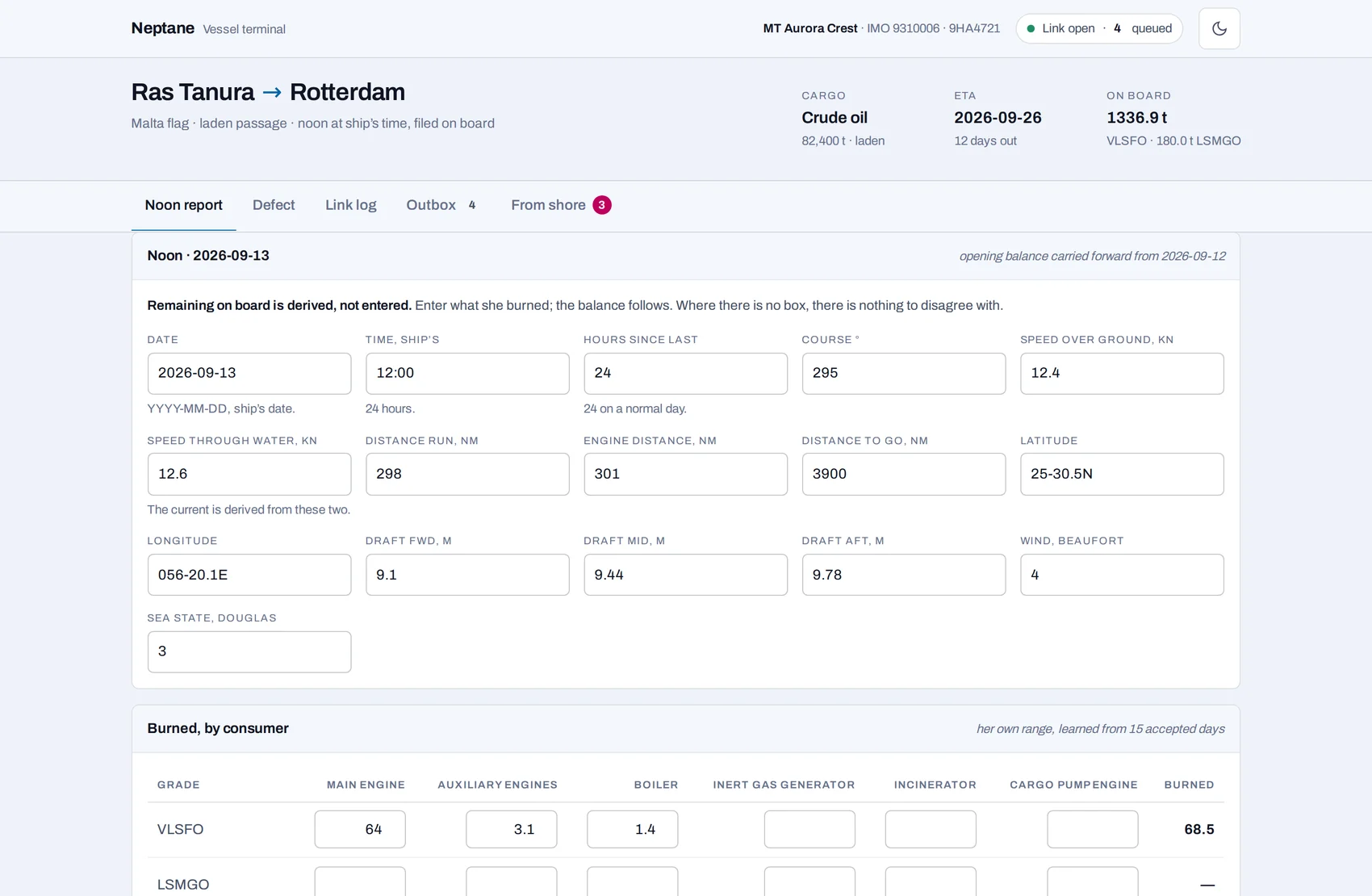
From shore, an outage and a switched-off bridge PC look identical. The terminal keeps its own hourly record of what the link actually did, and the hours it was not awake for are left as a gap rather than counted as an outage. Your coverage figure is measured, not assumed.
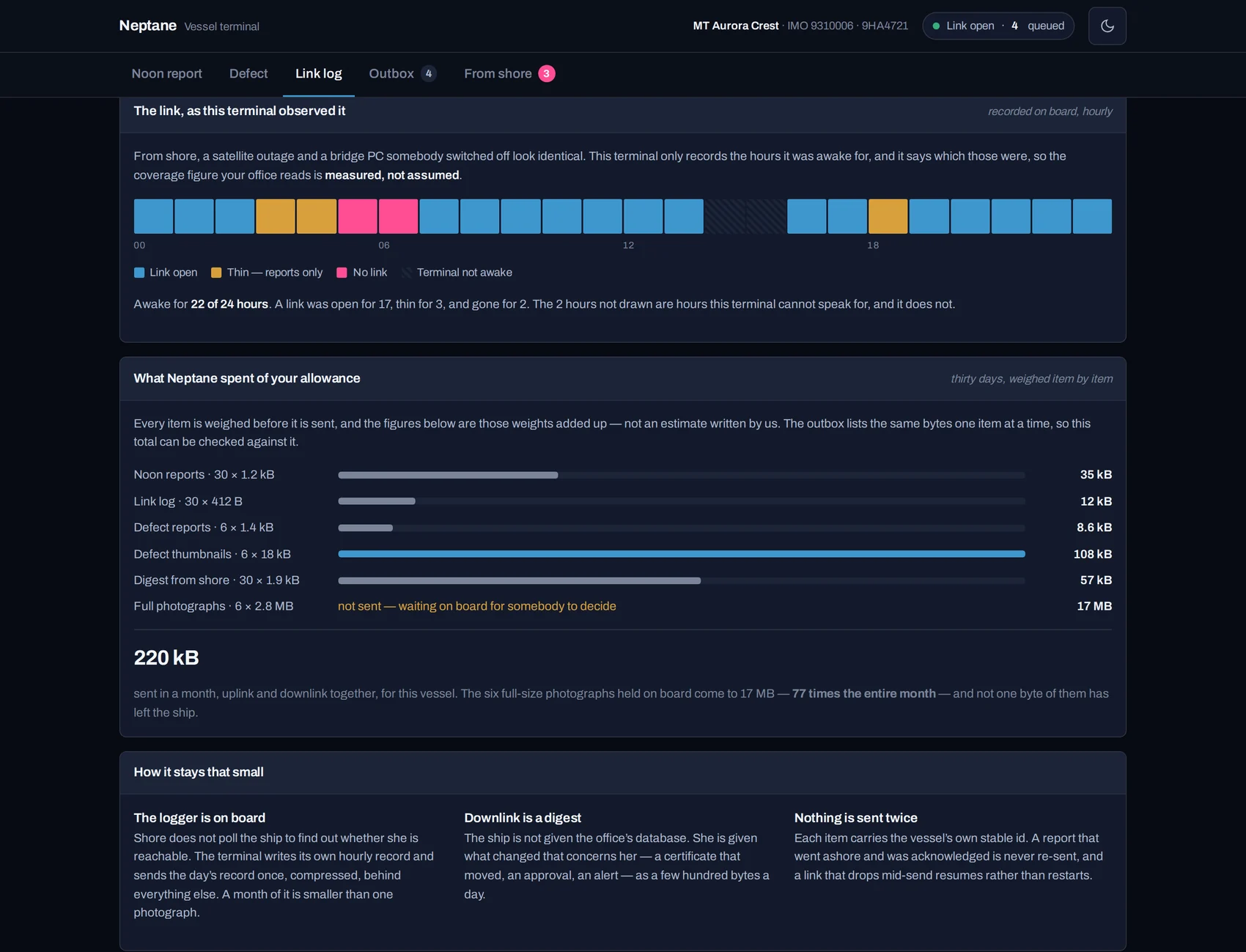
Thirty days, twenty-two vessels
Demonstration fleet of twenty-two invented vessels. Nothing filed is ever missing; it is only late.
| Day | Filed on board | Ashore same day |
|---|---|---|
| Day 1 | 22 | 22 |
| Day 2 | 22 | 22 |
| Day 3 | 22 | 21 |
| Day 4 | 22 | 22 |
| Day 5 | 22 | 19 |
| Day 6 | 22 | 16 |
| Day 7 | 22 | 15 |
| Day 8 | 22 | 18 |
| Day 9 | 22 | 22 |
| Day 10 | 22 | 22 |
| Day 11 | 22 | 22 |
| Day 12 | 22 | 20 |
| Day 13 | 22 | 22 |
| Day 14 | 22 | 22 |
| Day 15 | 22 | 17 |
| Day 16 | 22 | 14 |
| Day 17 | 22 | 16 |
| Day 18 | 22 | 21 |
| Day 19 | 22 | 22 |
| Day 20 | 22 | 22 |
| Day 21 | 22 | 22 |
| Day 22 | 22 | 22 |
| Day 23 | 22 | 21 |
| Day 24 | 22 | 19 |
| Day 25 | 22 | 22 |
| Day 26 | 22 | 22 |
| Day 27 | 22 | 22 |
| Day 28 | 22 | 22 |
| Day 29 | 22 | 20 |
| Day 30 | 22 | 22 |
Two vessels, one quarter
One file per vessel, activated once. Your crews keep their paper log throughout.
A vessel already running the terminal writes to support@neptane.io — the Master directly, if he wants to. It does not go through your office first.